Ignite 2025 (Part 4): Your 90-Day Winter Modernization Plan
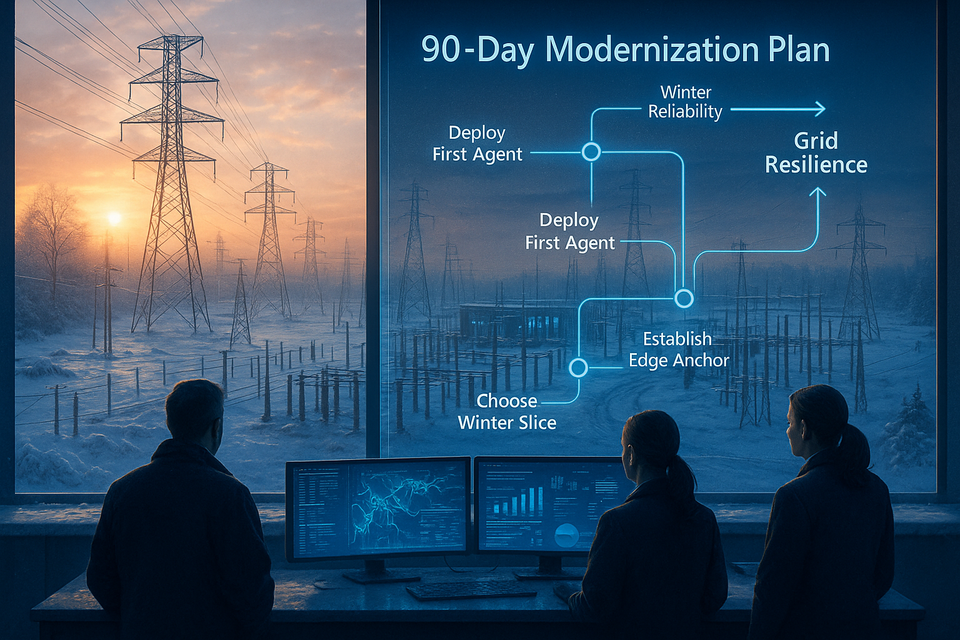
Final Part of the Azure411 Winter Grid Series
The storm is finally easing.
Wind settles. Snow softens. The grid hums with that familiar post-weather quiet — the sound of a system that held the line, supported by operators, by infrastructure, and now by a layer of intelligence that wasn’t there last winter.
If Part 1 showed the storm through the operator’s eyes…
If Part 2 revealed the new Azure engine room…
If Part 3 followed crews into the frozen substations…
Part 4 is about what happens next.
When the snow melts, when the reports come in, when budget conversations start, and when leaders ask:
“How do we make this our new normal?”
This is the 90-day plan.
Concrete. Achievable. Built to show value before the next cold front arrives.
Step 1 - Choose Your “Winter Slice” (Week 1–2)
Don’t modernize the entire grid.
Pick one domain that winter exposes every year:
- A storm-prone region
- A substation cluster with chronic ice issues
- A plant that derates every January
- A forecasting scenario that always misses the mark
This domain becomes your Winter Pilot.
Give it a name.
Give it an owner.
Make the scope small enough to execute, big enough to prove value.
The Fabric IQ/Foundry IQ modeling announced in the Ignite Book of News is built exactly for this kind of slice-based modernization:
https://news.microsoft.com/ignite-2025-book-of-news/
Step 2 — Build the Shared Data View (Week 2–4)
This is where teams finally stop arguing about “which system is right.”
Use Fabric IQ to define 5–10 business entities:
- Feeders
- Substations
- Transformers
- Critical customers
- Weather boundaries
- Outage history
Then use Foundry IQ to bind SCADA, AMI, asset data, weather feeds, and maintenance logs into one unified semantic view.
Not a full enterprise model.
Just the truth for your Winter Slice.
Once this view exists:
- Operators trust the data
- Planners trust the trends
- Finance trusts the impact
- Execs trust the story
And winter starts to look predictable rather than chaotic.
Step 3 - Deploy Your First Agent (Week 4–6)
The biggest mistake utilities make is trying to deploy five Copilot agents at once.
Start with one job:
- Outage triage for a single region
- Load forecasting assistance for winter peaks
- Maintenance prioritization for two plants
- Holiday volatility risk modeling
Use the Ignite-announced Foundry Agent Service to deploy safely inside your governance boundary.
Pick three KPIs:
- Faster decisions
- Fewer false alarms
- Reduced effort
Review at 30 / 60 / 90 days.
This is not a moonshot.
It’s deliberate, controlled, and value-oriented, just the way conservative modernization should be.
Step 4 - Establish Your First Edge Anchor (Week 6–10)
Choose the site that suffers the most when backhaul fails:
- A remote substation
- A winter-vulnerable plant
- A rural operations hub
Deploy Azure Local with:
- Local AKS
- Local Fabric IQ entities
- Local Database
- One agent running offline
- Clear sync rules for when the WAN returns
This is where Part 3’s story becomes real:
The next winter storm won’t disconnect your intelligence, it’ll run locally.
Step 5 - Bring Finance & Compliance Into the Loop Early (Week 8–10)
Avoid year-end budget battles by showing:
Finance:
- Cobalt 200 reduces simulation costs
- Boost reduces infra sprawl
- Azure Local reduces truck rolls and outage minutes
- Scenario depth = fewer procurement surprises
- Reliability = better rate-case positioning
Compliance:
- Fabric IQ = better transparency
- Foundry IQ = better data lineage
- Copilot = RBAC-bounded decisions
- Azure Local = edge control at regulator-friendly precision
This is where you turn technology into justification.
Step 6 - Deliver Your “Before vs After Winter” Story (By Day 90)
In February, when the board or regulator asks for winter performance:
You show:
- “This region restored 16 minutes faster on average.”
- “We ran 12× more planning scenarios during the December freeze.”
- “Substation 14 stayed fully operational during WAN loss.”
- “Forecast accuracy improved by 9% on peak mornings.”
This is your winter win story - built from three months of targeted progress.
It becomes your argument for scaling in spring.
Winter Series Wrap-Up
Over four days, we explored:
Part 1: A winter storm experienced through an AI-ready grid
Part 2: The new computational backbone behind Azure’s winter intelligence
Part 3: How Azure Local turns substations into resilient, autonomous edge sites
Part 4: A practical, 90-day modernization plan that starts small but proves big value
Winter exposes weakness.
Ignite 2025 gave us tools to replace weakness with foresight.
Now it’s your move:
- Pick one Winter Slice
- Build one Shared Data View
- Launch one Agent
- Anchor one Edge Site
- Tell one clear story
Do that, and by next winter your grid won’t hope for resilience, it will be designed for it.