The friction that forced 90-day pilots is no longer technical - it’s organizational.
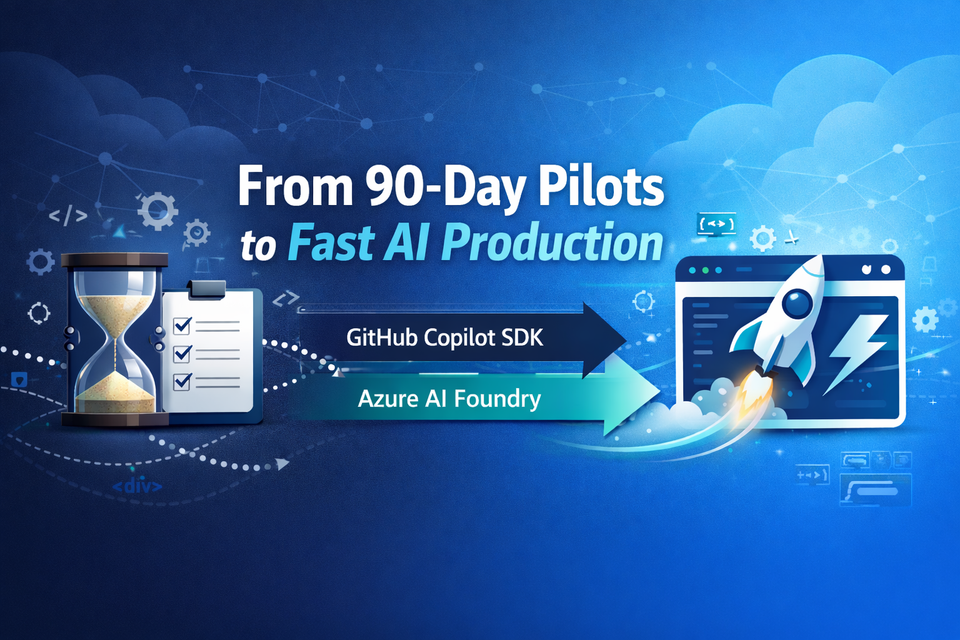
Published on Azure411 | By John Stelmaszek
The same Monday. Three different outcomes.
It's early Monday morning. Three organizations sit down with the same goal: get an AI-powered workflow into production.
Company A is a mid-sized engineering consultancy. By Thursday afternoon, their project management tool could be thinking for itself. The GitHub Copilot SDK embedded directly inside it, not bolted on, not adjacent to it, inside it, connected to Azure AI Foundry, pulling context from five years of past proposals, drafting new ones with 90% of the boilerplate already done. The senior partner who spends six hours on every proposal could be spending forty-five minutes reviewing one. They could ship Friday.
Company B is a regional electric utility. Not a software company. Their data lives in process data historians, GIS platforms, and asset management systems that talk to each other through spreadsheets and prayer. But they have a clear problem: 200 miles of transmission right-of-way, and in a severe ice storm, a single vegetation contact on a bulk electric system line can cascade into a catastrophic regional outage. Three weeks after that Monday, their vegetation management planning application could be reasoning across five data systems simultaneously: weather forecasts, LiDAR encroachment data, outage history, asset scores, financial exposure. All inside the tool the planner already uses. Powered by the GitHub Copilot SDK, Azure AI Foundry, and Foundry IQ. The planner wouldn't open a new portal. The application would become intelligent.
Company C is still in discovery. It's day 60. The architecture review board met last Tuesday to discuss the charter for the AI governance subcommittee, which will eventually produce recommendations for the vendor evaluation team, who will present options to the steering committee in Q3. Companies A and B could be shipping. Company C is drafting meeting agendas.
Company C isn't slower because their problems are harder. They're slower because their org chart is harder. That's the real story of AI deployment speed right now. If you recognized yourself in Company C before I finished the sentence, this post is for you.
The compression event: What actually changed
Twelve months ago, the 90-day pilot was defensible. Models were inconsistent. Tooling was fragmented. Integrating AI into a line-of-business application meant duct-taping APIs together and hoping your prompt engineering held under production load. That world is gone.
Claude Opus 4.6 brought 200K-token context windows into production-grade reasoning, letting an agent ingest an entire codebase or five years of sensor data in a single pass and reason across it coherently, without chunking gymnastics.
GPT-5.3 Codex doesn't suggest code; it implements autonomously across multiple steps, handling boilerplate, connector logic, and error handling. In a build like Company B's, early adopters estimate roughly 80% of integration code handled by the model for well-documented APIs (illustrative, not a published benchmark).
Azure AI Foundry matured into a production-grade enterprise platform: Foundry IQ provides a managed knowledge layer that unifies disparate data sources, and Foundry Agent Service handles multi-agent orchestration at enterprise scale.
And then there's the shift that matters most for how your business actually works: the GitHub Copilot SDK.
As of January 2026, the GitHub Copilot SDK is in Technical Preview, available in Python, TypeScript, Go, and .NET via the github/copilot-sdk repository. The underlying agentic runtime is the same production-tested engine behind Copilot CLI. The SDK wrapper carries the standard Technical Preview caveat: it may not yet be suitable for all production use cases. Evaluate with the rigor your risk posture requires. Organizations building familiarity now will be a full cycle ahead of those waiting for general availability.
What it is. The GitHub Copilot SDK takes the same agentic execution loop that powers Copilot CLI and makes it an embeddable component your developers drop into any line-of-business application: your vegetation management planner, your inventory tool, your compliance system. The GitHub Copilot SDK handles planning, tool invocation, multi-turn reasoning, session state, and streaming results. The user sees intelligence inside the tool they already use.
Why it matters for your timeline. Before the GitHub Copilot SDK, building an intelligent application meant constructing your own agent framework from scratch: the planning loop, tool invocation layer, session management, streaming infrastructure, error handling, model routing. That's weeks of platform engineering before your team writes a single line of domain logic. The GitHub Copilot SDK eliminates that entire layer, letting your team skip straight to the part that requires their expertise: defining what the agent should do, what data it needs, and how it surfaces decisions to the user. That's why Company A ships in five days instead of five weeks.
How it works in practice. Your developer installs the GitHub Copilot SDK, configures BYOK to connect to your Azure AI Foundry instance so model inference stays within your Azure tenant under your API keys, defines custom tools or MCP server connections to your internal data sources, and writes the agent's behavior and guardrails. The GitHub Copilot SDK manages session lifecycle and model routing; enterprise identity, RBAC, and conditional access belong to Entra ID and your application's authorization logic. Your developer focuses on domain logic.
How it relates to Azure AI Foundry. They're complementary, not competing. The GitHub Copilot SDK is the agent runtime you embed in your application. Azure AI Foundry provides the enterprise data layer via Foundry IQ, production orchestration via Agent Service, and the governance envelope your compliance team requires. The GitHub Copilot SDK is how your application thinks. Azure AI Foundry is where it connects to your data and meets your compliance requirements.
In production, the stack layers cleanly: your application embeds the GitHub Copilot SDK, which manages the agent runtime as a headless background service (your users never see a console or CLI). To route model inference through your own Azure AI Foundry instance, you configure BYOK with your endpoint URL and API key in a single configuration object, and all inference stays within your Azure tenant. Foundry IQ provides the knowledge layer. Identity flows through two distinct layers. At the data layer, Foundry IQ runs queries under the caller's Entra identity, synchronizes access control lists from connected sources, and honors Purview sensitivity labels at query time, so the agent only retrieves content the authenticated user is authorized to see. At the model layer, inference authenticates via the BYOK API key, not user identity; no Entra tokens or user claims are passed to the LLM. Your application authenticates the user via Entra ID and passes that identity context to Foundry IQ for permission-aware retrieval, while model inference stays on API key auth. Data access is identity-scoped. Model inference is key-scoped. Both are within your Azure tenant. Azure Monitor and Application Insights provide operational telemetry. Azure AI Content Safety enforces content guardrails on model inputs and outputs.
Your applications don't call an AI service. Your applications are intelligent.
Three tiers of speed. Which one are you?
Tier 1: 5-7 days. Software companies, engineering consultancies, cloud-native SaaS providers. API-first, mature CI/CD, data in structured systems with documented interfaces. A week is genuinely achievable when organizational friction is low and the stack is ready. Company A isn't a unicorn. It's what happens when the platform engineering is already done and your team can go straight to domain logic.
Tier 2: 2-3 weeks. Energy companies, manufacturers, financial services firms, healthcare systems. Legacy integration challenges, compliance gates, OT/IT boundaries that don't move easily. But Foundry IQ and the GitHub Copilot SDK collapse the hard parts. Foundry IQ indexes Azure Blob Storage, SharePoint, and OneLake in place; OT historian data bridges via PI Integrator or Azure Data Factory before indexing. Three weeks isn't heroic for a Tier 2 organization. It's what becomes achievable when you stop trying to solve the data migration problem and start using tools designed to work around it.
Tier 3: 60-90 days (and slipping). Here's the uncomfortable truth: Tier 3 isn't slower because the technology is harder. The technology Company B would use, a utility with five legacy data systems and a regulated operating environment, is more complex than most Tier 3 projects. Tier 3 is slower because of decision velocity: architecture review boards that exist to approve decisions rather than make them, vendor evaluation processes that outlast the problem they were designed to solve. Tier 3 is an organizational problem wearing a technology costume.
Let's see what these timelines look like in the real world, starting with the fastest.
Five days. One team. In production.
Company A isn't fantasy. In five days, a team stands up Azure AI Foundry, embeds the GitHub Copilot SDK in the proposal tool, connects Foundry IQ to five years of past proposals, configures Entra ID for identity boundaries and Azure Monitor for operational telemetry, and deploys to production. The stakeholder demo is the live system.
Illustrative month-one ROI: Twenty-five proposals in month one, each taking forty-five minutes instead of six hours. At a blended rate of $200/hour, roughly $26,000 in recovered capacity from a five-day build. Not in year three. In month one.
The math looks different when the stakes aren't hours but outages.
The agent that sees across silos
Company B's scenario is the one that should matter most to anyone in a regulated, asset-heavy industry, because it shows what embedded intelligence looks like when the problem is genuinely hard.
The traditional approach to managing vegetation along an electric transmission right-of-way: divide the 200-mile corridor into sections, schedule contractors to trim on a rotating basis, and hope the calendar aligns with actual risk. It doesn't. You trim the wrong things at the wrong time and miss the oak branch that's been slowly encroaching on the Ridgeline-to-Oakdale 138kV line for three years. Vegetation management on bulk electric system transmission lines isn't just an operational function. It's a compliance function governed by NERC FAC-003, the federal standard requiring utilities to maintain minimum clearances, document their programs, and produce audit evidence on demand. A vegetation-caused flashover means NERC penalty assessments on top of direct outage costs.
Then you get an ice storm.
The utility's vegetation management planner has been working across five different data systems for ten years: a GIS platform for LiDAR encroachment data, a process data historian for outage history, an asset management system for equipment condition scores, a financial system for outage cost modeling, and whatever weather service the ops team bookmarked this month. The intelligence exists in those five systems. But no human can hold it all simultaneously and act on it in real time. That's not a data problem. It's a coordination problem, and exactly the kind of problem AI agents are designed to solve.
Now imagine the GitHub Copilot SDK living inside the vegetation management planning application she already uses. The planner opens her work queue. The application has already correlated, overnight, using Foundry Agent Service: the 72-hour NOAA ice accumulation forecast for each line segment, LiDAR-derived vegetation encroachment scores from the most recent aerial survey, five years of outage history from the process data historian weighted by storm conditions, asset condition scores, and modeled financial exposure.
It surfaces a recommendation:
"Cut the oak at mile marker 14.2 on the Ridgeline-to-Oakdale 138kV line. LiDAR clearance: 2.1 ft; projected ice load sag: 4.3 ft; historical contact rate at this clearance in prior ice events: 3 of 4. Estimated trim cost: $340. Average outage cost for a single-incident event at this location: $127,000 (based on approximately 2,500 affected customers, a 4-hour restoration window, and blended residential/commercial rate classes). Recommended action: generate work order for vegetation management contractor dispatch."
One tree. One decision. One work order routed to a vegetation management contractor. $126,660 in expected value preserved in a single morning recommendation.
That recommendation feeds the established workflow: routed through Maximo or SAP, dispatched through the normal contractor scheduling process. The AI surfaces the decision; the work management system handles execution. For FAC-003 compliance, every recommendation is logged with its source data, making the audit trail traceable rather than reconstructed after the fact.
What does it take to build this? Foundry IQ indexes data from Azure Blob Storage, SharePoint, and OneLake. OT historian data and GIS records are bridged to Azure Blob or OneLake first via PI Integrator or Azure Data Factory, then indexed alongside the financial and asset management data. The GitHub Copilot SDK embeds in the existing planning application via BYOK to the utility's Azure AI Foundry instance. GPT-5.3 Codex handles an estimated 80% of the integration code across all five systems via MCP server connections (illustrative; proprietary OT interfaces require additional developer guidance).
Realistic timeline from Monday to production: 18 days, for non-CIP-critical systems or with parallel compliance review. If the application connects to systems under NERC CIP requirements, CIP-010 configuration change management typically adds review cycles through the change advisory board, which is exactly why scoping to CIP-exempt planning applications or running the compliance review in parallel with the build is the right move.
The same pattern. Every industry. Your industry.
Once you see the GitHub Copilot SDK pattern, agent embedded in the existing application and Foundry IQ unifying the data, you start seeing it everywhere.
Retail inventory management. Demand planning systems already surface probabilistic stockout risk. The gap is that those recommendations don't synthesize across open-to-buy constraints, promotional lift from marketing, and lead time variability from the supplier portal. The GitHub Copilot SDK embeds that reasoning in the tool where the buyer already works. The inventory application says: "Reorder SKU 38847-B: 400 units by Thursday. Current on-hand: 34 units, 1.2 days of supply. Current velocity plus 40% estimated promotional lift: 94% stockout probability by Saturday. Supplier lead time: 2 days. No open purchase orders for this SKU. Projected PO cost: $8,200. OTB available in category: $31,400. Recommended action: approve reorder." Your buyer isn't doing triage. They're approving. Decision-grade, not information-grade.
Financial compliance. The old way: a suspicious activity report queue with 200 flagged transactions and no context, leaving your BSA officer to reconstruct the story behind each one. The new way: the compliance tool does it first. "Flag account AC-882341. Three cash deposits in the past 18 days: $9,400 on February 3rd, $9,700 on February 10th, $9,500 on February 17th. Total: $28,600. Pattern consistent with structuring to evade Currency Transaction Report filing requirements under 31 CFR 1010.314. Originating account shows no prior cash activity at this volume. Recommended action: escalate to BSA officer for SAR determination." Not a queue. A decision. Your BSA officer spends time on the cases that require judgment, not the ones that require lookup. That's a material difference in both compliance velocity and team capacity.
In every case: the applications are intelligent. Not calling a service. Reasoning inside the tool where the decision happens.
The 90-day trap: What it actually costs
Why does Tier 3 still exist? Vendor evaluation cycles designed for infrastructure procurement applied to AI use cases that will be obsolete before the evaluation concludes. Architecture review boards treating a two-week GitHub Copilot SDK integration, with Entra RBAC configured at the application layer, Azure Monitor audit trails, and BYOK data residency managed through your Azure tenant, like a data center expansion.
What does Tier 3 actually cost?
Take a comparable professional services firm, running conservative numbers on proposal generation. Twenty-five proposals per month, 4 hours saved per proposal, $150/hour fully loaded. That's $15,000 per month unrealized, per month of delay.
At utility scale, where one avoided single-incident outage preserves $127,000 in expected value and the system might prevent four per year, the per-month delay cost is over $42,000 in expected value.
Across three or four AI use cases ready to deploy but stuck in governance? $112,000 or more in directional monthly opportunity cost, a rough composite of per-use-case delay figures. Run it with your own numbers. The direction is what matters.
That's not a technology cost. That's a decision cost. And your competitor isn't paying it.
The compliance argument. The legacy data argument. Both wrong.
"We have compliance requirements." Good. Entra ID, Azure Monitor, and BYOK were built for exactly this. Entra ID is the identity boundary, applied at the application and Azure AI Foundry layer, not inside the GitHub Copilot SDK itself. BYOK keeps model inference within your Azure tenant under your API keys. Session orchestration metadata passes through GitHub's Copilot infrastructure, so regulated-industry organizations should review GitHub's data handling documentation for their specific residency requirements. Azure Monitor and Application Insights log every agent action and tool invocation for the operational audit trail. Purview handles data governance, lineage, and sensitivity labeling across the data sources the agent accesses. Compliance isn't a reason to go slow. It's a reason to use Azure's governance stack rather than building your own.
"Our data is in legacy systems." That's precisely what Foundry IQ was designed to solve. A managed knowledge layer over Azure Blob Storage, SharePoint, and OneLake, without migrating or rebuilding those source systems. For OT historian data, a one-time bridge via PI Integrator or Azure Data Factory to Azure Blob or OneLake is the starting point; after that, Foundry IQ indexes it alongside your Microsoft-ecosystem data. In Company B's scenario, the source systems stay exactly where they are. The GitHub Copilot SDK reasons over everything via MCP integration. Your legacy architecture is not the obstacle you think it is.
Your sprint playbook
If you're Tier 1: Stand up Azure AI Foundry this week, embed the GitHub Copilot SDK in the application your team uses most, connect Foundry IQ to your two or three primary data sources, and ship in five days. Measure the output. Expand from there.
If you're Tier 2: Start with Foundry IQ in week one: bridge your historian data to Azure Blob or OneLake via PI Integrator or Data Factory, connect your asset management system and primary operational data sources, and let Foundry IQ index them in place. Identify the single application where decision-grade intelligence has the highest impact, embed the GitHub Copilot SDK there, and engage compliance and security in week one, not week six. The Azure Monitor audit trails, Entra RBAC, and BYOK controls are already there. Three weeks is realistic; six weeks means something in your process is broken.
If you're Tier 3: This is not a technology problem, stop treating it like one. Name the actual blocker: a specific person, a specific committee. Find one executive who will own a 30-day delivery mandate on a single use case and shield it from the review board cycle, then run the Tier 1 playbook inside that mandate and negotiate the second deployment from demonstrated results, not theoretical risk assessment.
The question you actually need to answer
The tools exist today. The GitHub Copilot SDK repo is there right now. An 18-day path from Monday to production is realistic for organizations willing to scope correctly and run compliance review in parallel.
The question isn't whether your organization is ready. Ready is a destination that never arrives. Company A doesn't wait to be ready. They ship, measure, and get ready by doing. The question isn't whether the ROI is real. Run the numbers with your own blended rates. A five-day build that recovers $26,000 in month one doesn't need a business case. It needs a start date.
Here's the question: What did your competitor ship while you were reading this?
The organizations that move now will be six weeks into their second and third use cases while you're still finalizing your first. They'll have production telemetry, ROI data, and a board presentation that says "we're ahead." That gap compounds. Pick one use case. Name an owner. Set a 30-day date.
John Stelmaszek is a Principal Architect and founder of Azure411, focused on practical Azure AI deployment for enterprise and regulated industries. Connect on LinkedIn or reach out directly at azure411.com.